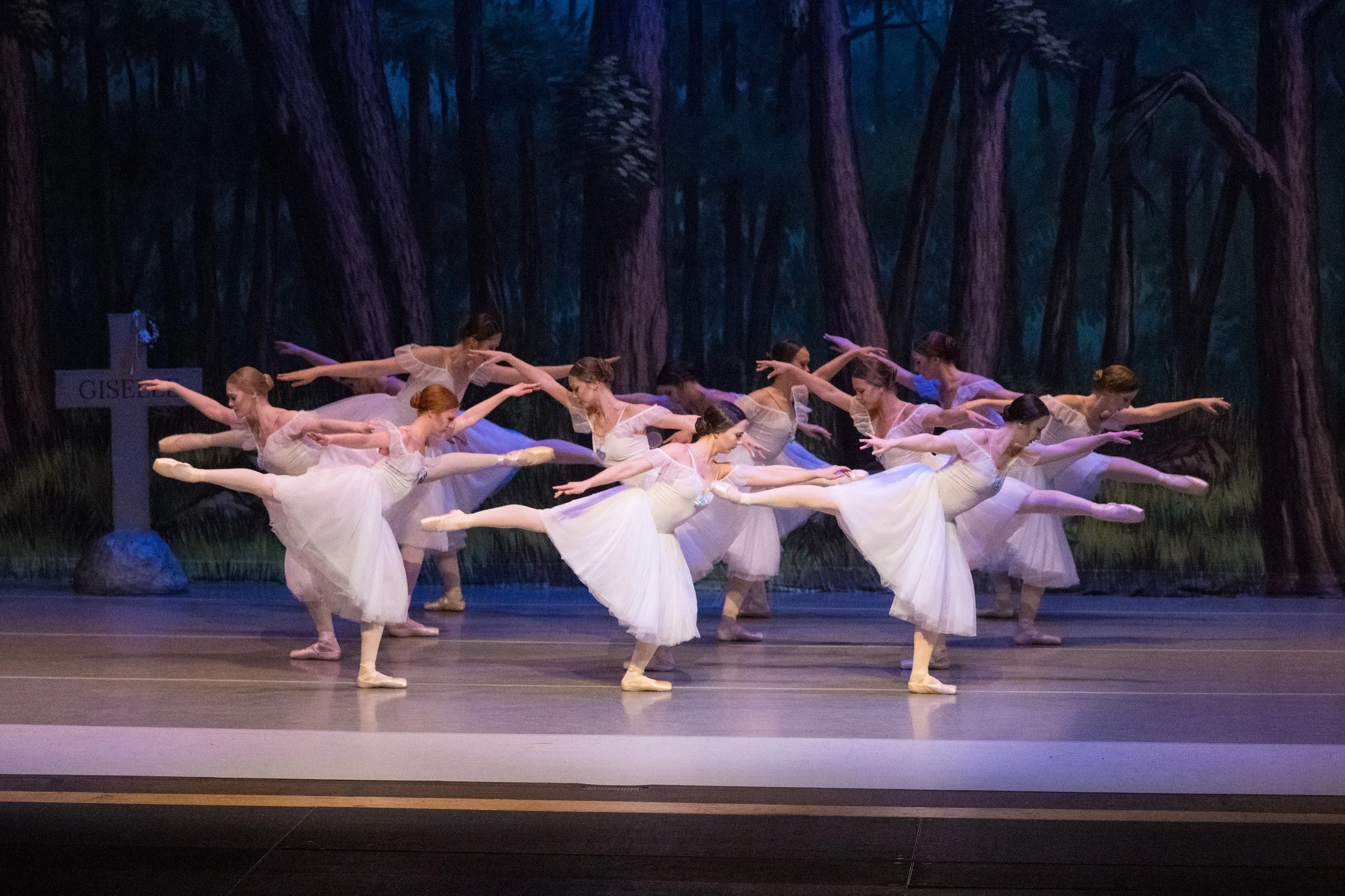
Join us for one of the greatest ballets ever created. Giselle is a timeless story of love, betrayal, forgiveness, and the power of grace beyond the grave.
First performed in 1841, Giselle remains the most beloved ballet of the Romantic era. With sweeping music by Adolphe Adam and hauntingly beautiful choreography after Jules Perrot and Jean Coralli, this masterpiece has captivated audiences for generations.
The story follows Giselle, a gentle village girl who falls deeply in love with a young man she believes to be a simple peasant. When his deception is revealed, the heartbreak proves too much for her fragile heart. But death is not the end of Giselle’s story.
In a moonlit forest haunted by the Wilis—the spirits of maidens betrayed before their weddings—Giselle must confront the man who broke her heart. When he faces a terrible fate, she makes a choice that transforms tragedy into redemption.
Filled with breathtaking dancing, sweeping romance, and one of the most powerful second acts in all of ballet, Giselle is an unforgettable theatrical experience.
Performance Dates
Saturday, April 18, 2026 — 6:00 PM
Sunday, April 19, 2026 — 2:00 PM
Location
Mountain View High School Auditorium
Bend, Oregon
Presented by Central Oregon School of Ballet

Directors Note on Giselle
Few ballets hold the enduring power of Giselle. While titles like Swan Lake may be more widely recognized today, Giselle predates it and stands as the quintessential ballet of the Romantic era. Created for the great ballerinas of the 19th century, it tells a tragic story of love, loss, deception, fate—and ultimately the power of love to redeem even the undeserving through grace.
Synopsis
Act I
Giselle is a simple village girl—a peasant—who has fallen deeply in love with a young man she knows as Loys. Her innocence and naivety shine through in every gesture and movement. She loves to dance, though her mother constantly warns her that she has a fragile heart and must not overexert herself.
Poor Giselle—does the flutter in her chest come from too much dancing, or from the thrill of Loys’ hand in hers and his persistent pursuit of her affection?
Giselle’s innocence is sharply contrasted by Loys’ deception. He is not a simple villager at all, but Count Albrecht in disguise. He has dressed as a peasant so he can pursue Giselle without revealing his noble status—and without revealing that he is already betrothed to another.
He swears his love for her, but his actions betray the truth. Love does not dishonor others the way he dishonors Giselle. Love is not self-seeking in the way he pursues his own pleasure. Love does not delight in deception but rejoices in truth. His lies reveal that he does not truly love Giselle—at least not as much as he loves himself.
Another man does love Giselle sincerely: Hilarion, the village gamekeeper. He brings her flowers, provides food for her family, and chops wood for her mother. He sees through Albrecht’s disguise and seeks to protect Giselle from him.
Determined to expose the truth, Hilarion discovers proof of Albrecht’s nobility. Ironically, in his attempt to protect Giselle, the revelation shatters her. Overcome by grief and confusion, she descends into madness. In a tragic frenzy she dances herself to exhaustion, and her fragile heart fails her as she collapses into the arms of the man she loved—the man who betrayed her.
Act II
The curtain rises on a moonlit forest and Giselle’s grave, marked by the floral crown she wore as Queen of the Grape Harvest.
Enter Myrtha, Queen of the Wilis—spirits of young women who died with broken hearts after being betrayed by their lovers. The Wilis move in haunting unison, their arms lifted and wrists crossed, hands upturned as their lifeless eyes stare into emptiness. Their pose suggests the unfulfilled promise of happiness—the cradle that will never hold a child, the life that will never be lived.
Betrayed before their weddings, they now hate all men. Any man who wanders into their forest is forced to dance without rest until exhaustion claims him and he is drowned in the nearby lake. Their justice is swift and merciless.
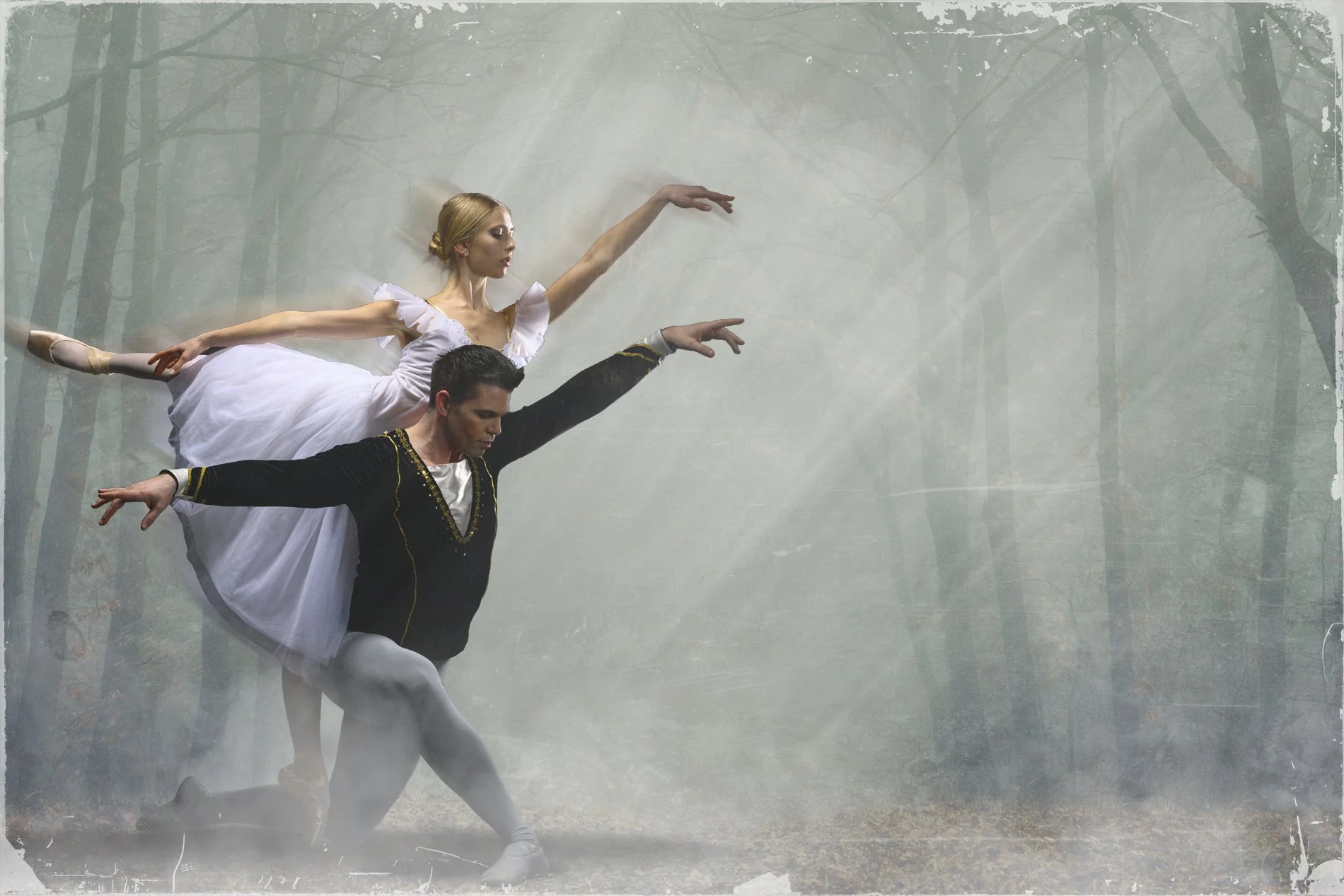
Albrecht enters the forest to grieve. Hilarion’s revelation has cost him everything—his honor, his betrothed, and the life of the girl he deceived. He kneels broken at Giselle’s grave.
Giselle appears before him, now one of the Wilis. She cannot touch him, and he cannot fully know whether she is truly there. In a heartbreaking duet, she slips again and again through his embrace like mist. Believing she might somehow still live, he follows her deeper into the forest.
Hilarion also enters the forest. Perhaps he is the most honorable man of the story—but he is still a man, and the Wilis show no mercy. They surround him relentlessly, forcing him to dance until exhaustion claims him and he meets his doom in the lake.
Soon Albrecht himself stumbles into the Wilis’ grove. Myrtha condemns him to the same fate.
But Giselle intervenes.
She pleads for mercy and places herself between Albrecht and the Wilis. She offers herself in his place. The power of her love breaks Myrtha’s command—yet the only way to save him is through dance.
Giselle begins a long, sorrowful adagio, stretching time as the night slowly passes. Again and again Albrecht is forced to dance while Giselle shields him, encouraging him, forgiving him.
As dawn approaches, the Wilis lose their power and fade back into their graves. In the first light of morning, Giselle’s spirit begins to vanish as well.
Albrecht gathers her in his arms one final time. Like a bride who will never cross the threshold of a home, she is carried back to her grave. She disappears forever, leaving him alive to face the life ahead.
Through her love and sacrifice, Giselle has led him through the darkness of night into the salvation of the rising sun.
Why Giselle Endures
Giselle places the audience in a powerful moral tension. We see the innocence of Giselle destroyed by Albrecht’s selfishness, and we long for justice. Part of us wants the Wilis to punish him for what he has done.
Yet deep down we know we are not innocent either.
And so we hope for grace.
In the end, Giselle is not a story about vengeance, but about the unconquerable power of love beyond the grave—and mercy triumphing over justice.
It is, in a sense, a love letter read in hindsight by Albrecht himself.
And it is signed with a broken quill:
Giselle.
The Theater
Mountain View High Auditorium is a very comfortable theater with wide aisles and great views from every seat.